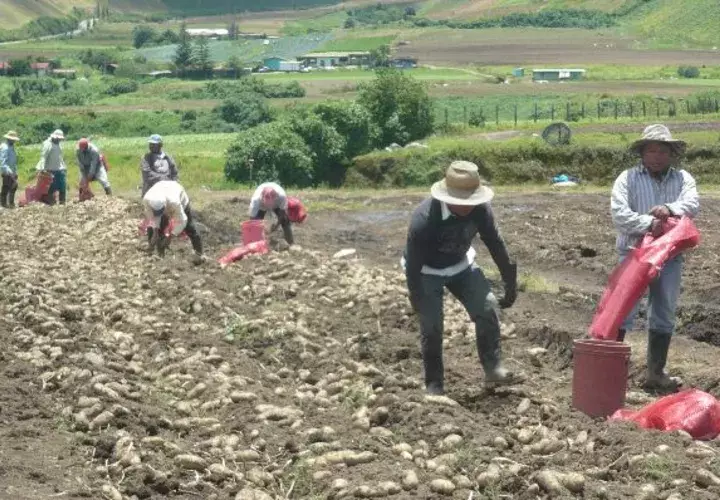
The El Niño phenomenon is starting to hit with greater force lands high Chiriquí, where 80% of the vegetables consumed in the country is grown, phenomenon which has generated an increase of between 25% and 50% on the price of this produce.
The situation worries producers and marketers of the vegetable market because they expected shortages of various products during the coming months. This will cause the prices to be even higher than those which are recurrent in December, when there is greater demand from consumers.
Currently, there is little onion in the market and there is no national cauliflower for sale, so imports are the alternative to meet national demand. This situation is contrary to the traditional position of producers, who complain that the market is saturated with foreign produce.
Augusto Jiménez, President of the Association of Producers of Highlands, explained that climate change in Cerro Punta is now definitely felt. "This year, the unique conditions of this sector have not been the same as last year", he stressed.
He highlighted that the harvest produced in March and April was planted between November and December, when it was rainy season, however, the summer has affected the production of onion.
The scarcity of this and other products is remarkably seen in the vegetable market, and as a result, the prices of main legumes rose between 25% and 50%, according to Morales Yori, Chairman of the Marketing Society.
He said that as a result of El Niño and the neglect in the sowing of vegetables, we have seen a shortage and a spike in products such as lettuce, cabbage, broccoli, cauliflower, celery and round tomato.
The producers have focused on the planting of potato, onion and carrot, neglecting the cultivation of vegetables, he said.
"In the market we need the majority of these products and, in a few days, the impact will be greater," he added.
"The high prices will be reflected in the chains of supermarkets, shops, grocery, hotels and restaurants, where sales have dropped by 20%," he said.
The low products have been noted in the food market which serving more than 5,000 people´s daily demand, and which is receiving, for example, about 40 thousand pounds of potatoes, when before about 150 thousand pounds were added.
The impact of the climate change not only is reflected on the effects in these products, there are other foods which it is also estimated will begin to scarce, such as pepper, melon, watermelon, squash and bean, from the areas of Caisán and Río Sereno, in Chiriquí.
One of the hardest hit sectors with low production of vegetables is hotels and restaurants offering salads in their menu.
Rino Tamburrelli, advisor and former President of the Association of Restaurants and Similar of Panama (Arap), stated that should the vegetable shortages continue, they will have to opt for other alternatives that substitute salads offered in the menus.
Tamburrelli added that in previous years the shortage of vegetables and crops was also happening, but the situation was less severe that that occurring this year because of El Niño phenomenon.
Meanwhile, producers make a call to the Ministry of Agricultural Development (Mida) for them to take measures in this situation.
Jorge Arango, Minister of Agriculture, told Panama America that he has talked to some marketers, but that these have shown no concern. "I'm going to find out with other marketers," concluded the Minister of Agriculture.
High costs
The President of the National Union of Consumers and Users of Panama (Uncurepa), Pedro Acosta, believes that marketers seek any excuse to raise prices, while acknowledging that the market works on a free supply and demand system.
He insisted that consumers should check their consumption habits. "If we continue consuming those products at high prices, they will continue to sell at high costs, he said.
He said that price controls will not benefit low-income Panamanians, but companies that buy products wholesale.
Vegetables and crops, with a 25%, occupy the fourth place out of 18 positions among the products of the basic food basket that have increased in price the most, according to a survey conducted by Dichter & Neira in April.
El Niño hits the Highlands (of Chiriquí) and raises cost of vegetables
Augusto Jiménez, President of the Association of Producers of Highlands, explained that climate change in Cerro Punta is now definitely felt. "This year, the unique conditions of this sector have not been the same as last year", he stressed.