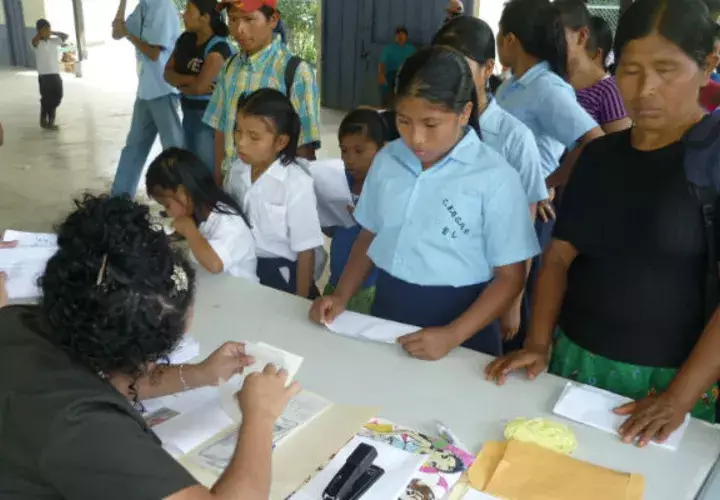
The State must invest in education and promote entrepreneurship to turn society into one that is productive and less dependent on the central government, both economists and business people agree.
For businessman and member of the Panamanian Association of Business Executives (Apede) Roberto Troncoso, the Government should refocus its social expenditure and take measures that encourage the growth of individuals.
This happened after an economic and social report of the Ministry of Economy and Finance (MEF) corresponding to the 2015 pointed out that the State allocated a budget of $10 thousand 870.8 million in social expenditure, which represents 48.4% of the total public expenditure.
Of this amount, $922.8 million (48%) were budgeted for conditional transfer programmes such as 120 a los 65, Red de Oportunidades, Becas Universales, among others, and another $476 million (52%) to companies such as transportation, electrical service, preferential interest and housing subsidies.
However, of the total budget, $9,481.6 million were executed, which represented 18.2% of gross domestic product.
Given this situation, Troncoso argues that Governments should be facilitators, and allow the private company, under the law, to develop their projects and become a generator of jobs.
For the entrepreneur, delivering an economic aid without guaranteeing the development of the individual means to create "a kind of parasitic society, used to depend on the central body".
He reiterated that the State programs should focus on developing entrepreneurship, the interest of looking for a job and the will to be better people.
Meanwhile, to economist Juan Jované, the refocusing of subsidies should start with the distinction between the financial support that has a political purpose from that which has a social and economic sense.
Jované argues that subsidies which have a real sense are those directed at education, health and food security.
Of the total of the budget provision in 2015 for social expenditure, 39.5% was directed to health, 26.4% to education, 16.7% to social work and social security, while 14.9% to multisocial programmes and 2.4% to housing programmes.
"It is better to link food security to education, than to universal allowances (becas universales) that do not have a general sense," he said.
For the Member of Apede, sustainability over time is also a situation which must be analyzed by the State.
"To a great extent, the contribution that the Panama Canal makes is destined to subsidize a part of society," he said.
To this, Jované added that if the State fails to ensure a good chance in the labor market to young people, the future shall be an excess in subsidies with no return granted.
He said that currently, 39% of the urban population is informal and is not in the system of social security, which in future would mean that more than 40% of the population will be beneficiaries of 120 a los 65.
Jované argues that employment makes more people to participate as social security contributors.
Authorities are not apathetic to this reality. Reviewing 110 exemption laws, subsidies and distribution of resources that govern the country is priority for the Ministry of Economy and Finance (MEF), if it is true that they intend to comply with the objectives of sustainable development (ODS) of the United Nations for the eradication of poverty.
For Jované, excess subsidies for vulnerable sectors is not the only problem that the country has. He reiterated that "Panama is one of the countries where people with high levels of income are least taxed".