


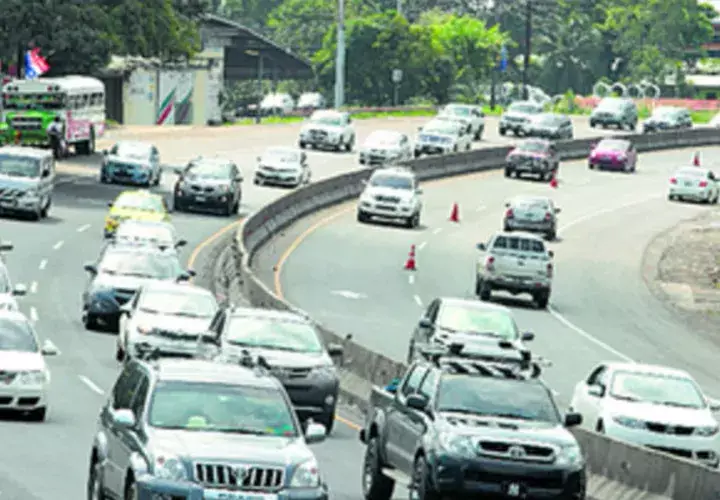
Low levels of productivity and high cost of operation because of the traffic chaos in the capital city concern due employers and employees.
Due to failures of the main roads, executives have seen the need to buy new equipment of transport and increase fuel expenditure and payment to brokers, the hiring of more staff and the cancellation of overtime.
Before this scenario, the Chamber of Commerce industry and Agriculture of Panama (CCIAP) had alerted authorities about the economic impact on the country due to traffic jams and demanded immediate solutions.
However, the concern of employers has its genesis in the year 2012, when reports produced by the Centre for Economic Studies of the CCIAP warned of an increase of up to 81% of the operating cost of firms due to crowding of the main roads.
The document also highlights a 21% decrease in daily business operations carried out by companies, and an increase of 70% in the purchase of trucks.
By 2014, the General Comptroller of the Republic recorded about 83 thousand 959 vehicles for cargo transportation, able to mobilize 354 thousand 616 short tons.
For then, the additional monthly cost of companies resulting from the traffic jams was at 5,416 dollars.
However, with the increase in parks for vehicles in recent years and the adjustment of the minimum wage, employers believe that this number may have doubled.
At the end of 2015, the Association of Automobile Distributors in Panama recorded the sale of 64 thousand 737 new cars, 7% more than in 2014.
However, operating costs are not the only impact that traffic jams have them on the business sector.
The deterioration of the quality of life of the collaborators who sacrifice time away from their families to travel to their jobs also affects economic development, warned the President of the Chamber of Commerce, Jorge García Icaza.
This statement is parallel to the President of the Union of Industrial of Panama (SIP), Ricardo Sotelo´s opinion, who argues that the fact that a person spends between 20% and 25% of their productive time in traffic, "is disastrous for a country's development".
According to a report by students of the Technological University of Panama (UTP), under the guidance of engineer Humberto Álvarez, the number of average weekly hours used by the Panamanians to go to work is 10 hours, only in the districts of Panama and San Miguelito.
Trade union associations indicate that, every day, thousands of Panamanians remain up to three hours in traffic, in journeys that would normally take them a little more than 30 minutes.
Mr. Garcia affirmed this situation is mainly due to a lack of planning.
He argues that the development of houses and business buildings in the city and its environs failed to go along with a plan of reorganization.
Meanwhile, former President of the National Council of the Private Company (Conep), Elisa Suárez, warns that the solution to this issue requires immediate action starting with improvement of the public transport service.
"Definitely, we don't eat streets, but without the streets and avenues, as well as an effective public transport, we cannot have development" she said.




Mr. Garcia added that the improvement of infrastructure, a decrease in the growth rate of the vehicle fleet and their circulation may also be of help.




Últimas noticias