
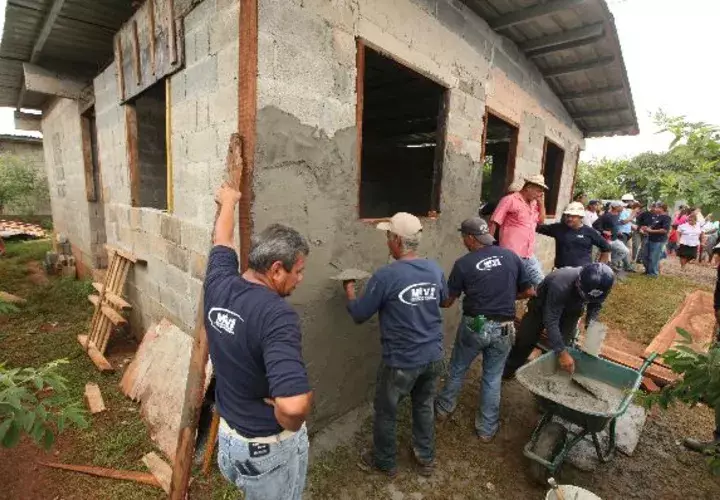
The 22 fields currently in operations as part of the government’s housing programme Techos de Esperanza would not suffice to achieve the proposed delivery goals over the next two years: to this
day, progress stands at a mere 5%.
One of the reasons behind such delays is that, of the total of 15,000 housing units under contruction, only 5,800 have actually have been awarded necessary construction permits by the Housing Ministry (Miviot).
Additionally, 15 projects are suffering from delays is the poor execution of the required administrative processes, whose extra costs add up to an estimated $150 million.Housing Minister Mario Etchelecu has clarified that all current construction fields are simultaneous working on 600 dwellings, representing 13,200 housing units. The construction of dwellings takes approximately one to one-and-a-half year, depending on the quantity of housing units. The vast majority is scheduled for delivery in 2017, according to initial plans. However, in the past five years, such a number of dwellings has, in reality, never achieved completion. In fact, there are projects that, in spite of time extensions to their original deadlines, are yet to be completed. Such is the case of the Urbanización Génesis project, which today stands at 70% completion rate. This is in spite of having 107 housing units ready for delivery: what is missing in this case is the formal transfer of property rights of the actual land.
Other projects have become embroiled in legal issues, as is the case for the Ave Fénix site, currently at a mere 22% completion, in spite of construction having started on 20 December 2013. This specific project has been suspended and is currently awaiting a Supreme Court decision: according to a report by the Housing Ministry: “the project’s construction contract is in the process of being terminated, and a new tender launched”. An Abundance of Irregularities
Progress Unknown in PM Investigation of Housing Ministry contracts
The feast of directly-awarded procurement contracts in Mario Etchelecu’s Housing Ministry has been going on un-phased. This is in spite of official complaints that much procurement has been carried out via the National Assistance Programme (PAN, in Spanish). The denunciation of irregularities has led to no apparent investigation on the part of the Public Ministry, even after Minster Etchelecu’s own admission that his institution had indeed used PAN-related funds. According to a declaration made at the beginning of 2016, Etchelecu stated that “it was decided that the funds destined to the PAN would be used to benefit the Techos de Esperanza project”. This declaration followed assurances that 2015 procurement for the project had been carried out via the proper channels, such as public tenders, through the Ministry’s own procurement department. The warnings of supposed irregularities voiced by Angélica Maytín, director of the National Authority for Transparency and Access to Information (Antai, in Spanish), seem to have carried little echo in the matter.