Two years have gone by since President Juan Carlos Varela took power, and the contrast between his hapless administration and the dynamism of former president's Ricardo Martinelli government could not be sharper.
The Varela Administration has failed to produce any strategically important project aimed at fostering the development of the country. Instead, it has focused on arbitrarily paralysing many of the public works projects that had been launched under the previous administration.
Even the very few, and much publicized, Panama City metro projects covering the construction of the second and third lines, were in reality developed by the previous administration.
President Varela has also blatantly failed to live up to some of his key electoral manifesto promises, such as the provision of affordable public housing, the supply of drinking water across the country, and the reduction in the basic cost of living.
According to lawyer Maribel Cuervo de Paredes, President Varela would appear to struggle to set out the strategic direction of his administration. “They simply seem unable to come up with a flagship project: they speak of the renovation of the city of Colon, they speak of building a fourth bridge on the canal; but beyond signing contracts, there appears to be very little planning on going on” she declared.
Former vice president Arturo Vallarino, for his part, finds the constant delays in the execution of promised public works, as well as the halting of construction activities relating to projects inherited from the previous administration, completely unacceptable. “On the one hand, the CSS has no capacity to see to patients' needs; on the other, the Varela administration arbitrarily chose to stop construction works in multiple healthcare projects, such as the Medical City complex in Panama City, the Minsa Carpi, and so on" he argued.
According to former President Ricardo Martinelli, " President Varela lives in an imaginary world: he refuses to change course, he refuses to give up his persecution of political opponents, and by his hateful actions he is destroying all the progress that Panama had recently achieved".
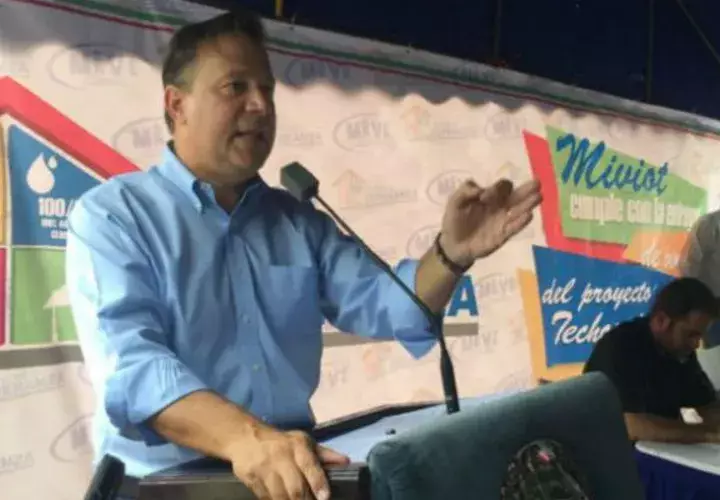
On top of all the criticism relating to the paralysis of previous administration's public work projects, the Varela government has also been singled out for engaging in much of the same activities that it has consistently and violently criticised former government officials for. For instance, the social housing programme “Techos de Esperanza”, has been accused of giving preferential treatment to favoured suppliers, eschewing proper public tender processes. To date, as regards the "Techos de Esperanzas" programme alone, there are 22 contracts that have been fractions and directly awarded to favoured companies, outside of public tender rules. A select number of businesses have been seen to benefit from such practice.
Ms. Cuervo de Paredes also highlighted how the Varela Administration has failed repeatedly to investigate and prosecute many cases of alleged corruption that have occurred during this government. She went on to add that "the greatest damage that Varela has done has been to fail to comply with his electoral promise of reducing the basic cost of living".
The state will be liable to lawsuits for breach of contract
The specter of multiple lawsuits brought by private companies against the Panamanian State for alleged breach of contract keeps raising its head. Multiple legal experts in public works contracts have highlighted how the arbitrary halting of many public work projects ordered by the Varela.



Administration could have serious legal and financial repercussions. To date, the comptroller general has notably failed to produce any evidence of misconduct or irregularities that could have served as a basis to justify halting projects initiated by the previous administration.
According to U.S. International arbitration expert Pedro Martinez Parga, "Panama ought to ensure it fulfils its contractual obligations towards private businesses that have invested in the country, if it wishes to avoid potential repercussions that could cost it millions of dollars." Mr. Martinez Parga went on to add that it’s important that Panama strengthen its legal framework to ensure it ca protect itself.
against possible lawsuits.
Contenido patrocinado


Últimas noticias