


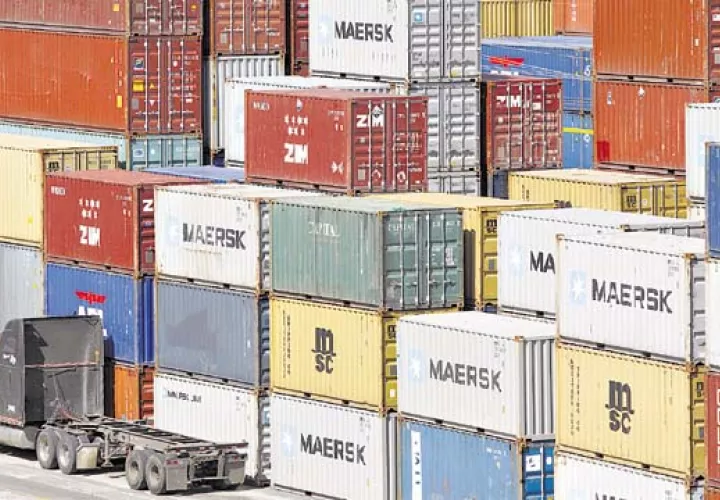
Truck drivers are united against a new levy that maritime terminal operators have decided to impose on them.
he $60 fee applies as of July 1 to drive drivers dropping off containers due for export.
The new fee comes into force as a result of Resolution ADM 125-2016 of the Panamanian Maritime Authority (AMP), which contains amendments relating to new health and safety regulation at sea
(SOLAS).
The AMP has authorized terminal operators to levy a fee for the service of load weighting as relates to containers due for export. Truck drivers complain that such service had up to now been free of charge.
The Panamanian Association of exporters (Apex) also criticized the new measure, arguing that the fees will make Panamanian port services less competitive internationally. Apex pointed out how
Panama is the only country in the region to have implemented such load weighting fee.
According to the federation of Central American exporters (Fecaexca), Panama exported some $536m in 2015, representing the lowest aggregate export across the region. There are fears that the
situation may get worse yet.
According to Gilberto Soto, a representative from the truck drivers association of Colon, regulations over weighting procedures had been expected to come into force since 2014. However, their
implementation had been procrastinated due to the failure of relevant parties to come to an agreement.
As a result, the AMP decided to give maritime terminal operators the prerogative of offering the weighting service for a fee. Mr. Soto denounced this as a sly and anticompetitive decision allowing
port operators to charge $60 for the service that they had thus far provided free of charge. In his estimates, Panama’s port operators are likely to see extra revenues of $18m annually thanks to this
levy.
Some 300,000 containers go through Panama's ports annually, "which, if multiplied by $60, adds up to an awful lot of money", he denounced.
Mr. Soto explained how "the authorities decided to place the financial burden of this new measure on truck drivers, instead of charging the clients of shipping companies directly for their load. This way it is up to truck drivers to pay upfront and then try and find a way of being reimbursed by the exporters”.
This presents serious challenges for truck drivers, since shipping companies can take up to 120 days before honoring their payments.
For his part, Antonio Garcia, treasurer for the Panamanian Association of truck drivers, denounced that Panama failed to coordinate the implementation of this new measure, causing each port terminal to choose its own weighting system.
This has resulted in delays, which have negatively affected the truck drivers, whose profitability is a function of the amount of daily loads they can carry.
Mr. Garcia has laid the blame directly had port operators, arguing that the latter are searching for ways of financing their own business through this new charge. He pointed out how in many cases,
such as for agricultural products, weighting occurs at the point of departure, and that port terminals only verify the accuracy of that information.
At the opposite end of the debate, Jose Aranda, deputy director for ports at the AMP, explain that this new $60 fee has been implemented in order to comply with international maritime security norms, and to ensure that exporters comply with the declared weight of their loads.