


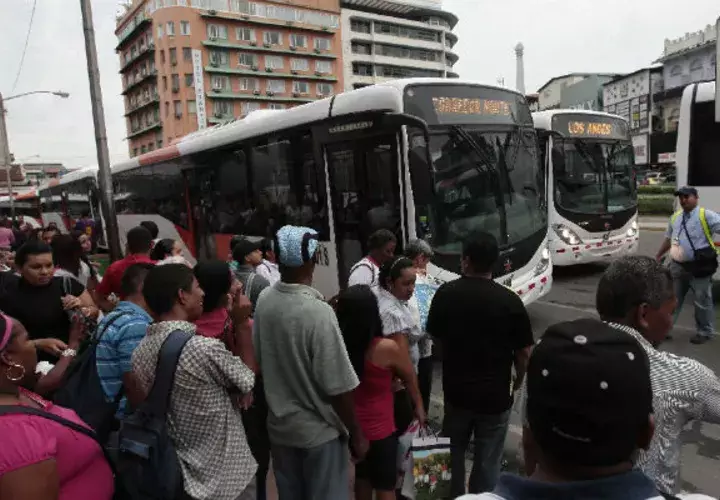
Users of public transport in the capital city have rejected the proposal of a unified fare for the metro and bus systems, at least while the serious operating problems of the bus system have not been addressed.
Carlos Gonzalez is one Panamanians who relies on the capital metro system on a daily basis. He says the metro has changed his life. 'I used to have to get up at 3.00 AM in order to be able to get to work on time';, he confessed: "now I get up at 4.00 AM, spend less money on transport and more time with my family'.
Mr. Gonzalez was adamant that the metro system has had a significant impact on the quality of life of many capital dwellers. However, he is skeptical about the government's proposal to unify metro and metro buses fares starting in 2017.
'Before the metro started its operations, getting on a bus used to be a daily challenge - there were simply not enough units operating with sufficient frequency to meet passengers demand", he explained. Accepting that the metro fare is quite cheap, Mr. Gonzalez nevertheless concluded that it is too early for the authorities to move to a unified fare system. “Although the service provided by the metro is excellent and quite cheap, the metrobus service remains poor”, he declared, adding that he “would be prepared to pay as much as 60¢ per fare, should the level of service warrant that”.
His view was echoed by Franklin Carles, representative of transport users for the board of the Authority for Road Transit and Transport (ATTT). “Both the metro and metrobus systems have to work optimally before the authorities should consider a unified fare”, he declared. While conceding that the current metro fare is very affordable, Mr. Carles nevertheless argued that 'the government has to wait until line two of the metro is operational before moving to raise metro fares'.
Someone who also voiced her opposition to fare increases is Arleen Mejia, leader of the Foundation for the Protection of Public Transport Users. According to Ms. Mejia, the authorities cannot expect to increase fares considering the serious inefficiencies of the metro bus operations. “If the authorities choose to increase fares, that should only apply to the metro system, and not to metrobus', she opined, adding that "users should be given ample warning in order to be able to prepare themselves for the new fare regime".
For his part, economist Juan Jovane argued that this is an unlikely time for the authorities to be contemplating an increasing transport fares. "Although the metro users are satisfied with their service and with the current fare levels, the authorities should wait for the economy to stabilize before introducing fare increases, considering that in the last year alone 11,000 jobs have been lost and Panamanians are struggling to make ends meet", he declared.
Metrobus subsidies
In 2014, in the middle of a crisis affecting the system, the ATTT considered a fare increase from $0.64 to $0.70. As a result of this, Mi Bus would receive an extra $50,000 dollars per day in return for transporting some 700,000 people.
By the end of 2016, Panama expects to receive 70 train wagons that will allow the metro system to operate with five instead of three wagons per train. This will increase capacity from 600 to 1000 passengers per train, as well as the fleet of trains from 20 to 25.
Metro de Panama S.A. has indicated that the production of the new units started in March this year, and that 'the supplier is making every effort to reduce delivery times'. The metro operator expects the first of the new trains to be operational by June 2017, once safety tests have been completed.
Tariff changes still to be defined
At the moment, a single fare on the metro is worth 35¢. Arguing this is quite low, Metro de Panama S.A. is considering an increase in the metro fare starting in 2017. In fact, the current fair system contemplates even lower fares for pensioners and students users of the metro. They pay 24¢ and 17¢, respectively.
In public declarations, the administrator of metro de Panama S.A., Roberto Roy, confirmed that the metro operator is 'contemplating an increase in fares, which would be also unified across the metro and metrobus system'.
Back in 2014, Mr. Roy had suggested amateur affair of between 60¢ and 65¢, arguing that the agreed level was too low. "I am sure that if fares were to increase, the president would ensure the system remains accessible", he reassured.
Maintenance
The metro system requires an annual expenditure of $52m for its maintenance and operation. Half of that money comes from state coffers, while the rest is covered by the fares paid by users. The proposed increase in fares remains at present unknown.