
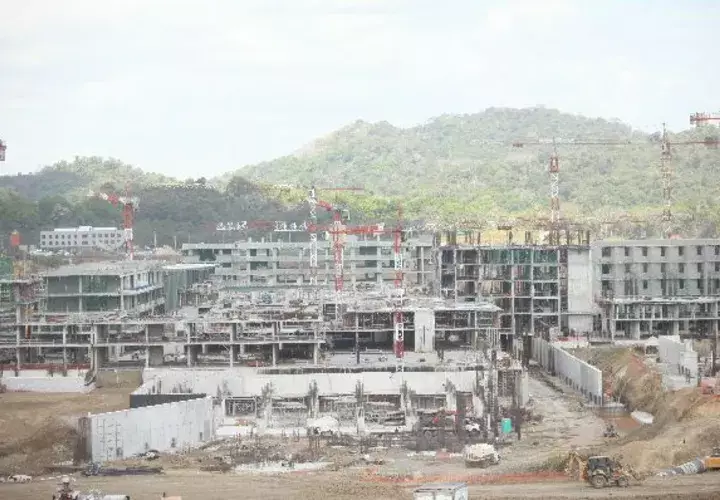
Every decision carries its own consequences. President Juan Carlos Varela’s ill-fated move to suspend public works worth $1.5 billion whose only crime was that of having been launched by the previous administration, could carry criminal consequences. Multiple legal sources have pointed out that no official justification has been yet produced by the Comptroller General regarding all the public works that have been arbitrarily suspended by the Varela Administration.
Baseless
“The Comptroller General is first in line to determine whether there have been willful pecuniary damages caused to the state coffers: for that purpose, an audit must be launched”, explains Ernesto Cedeño, a lawyer specializing in public works contracts. “In such cases, the comptroller general would launch an investigation ex oficio, and share the results with the Audit Tribunal. In the case of the 25 mega projects which have been paralyzed, whoever is responsible for their execution must be called to declare”, he went on to add.
This is an essential step in the process of determining whether the decisions taken by the administration have a legal base. The resulting information would then be available to the general public as well as to those private companies directly concerned by the suspension of works. “It is absolutely fundamental that the authorities explain to the nation what evidence was unearthed that justified be suspension of all public works in question”, Mr. Cedeño argued, adding that the authorities must clarify whether there exist a legal impediment for the works to resume.
Former vice president Arturo Vallarino added his voice to the choir lamenting that “the whole country is losing out as a result of the suspension of all those public works that had been launched by the previous administration”. He went on to describe “the state of disrepair” in which a hospital built in the province of Cocle has fallen: “Local people have been looting the premises or whatever they can get their hands on – it is a sad spectacle to behold, and one that is repeated across the country.”
Mr. Vallarino went on to speculate how the finance and economics ministry can possibly claim that 95% of its budget has been directed to public works launched by the previous administration: “I just don’t see anything being constructed: and I am afraid that all the private companies affected by the government’s decision will demand compensation. That will cost the State coffers much more than any alleged cost overruns.” he argued, adding that “many of the private companies touched by the government’s decision have abandoned the projects altogether: given how unreliable the government has been, it is unlikely they would ever return and resume work.” Mr. Vallarino lamented President Varela’s cookie cutter reaction to all these crises: “all he does is appearing TV advocating national unity! What the country needs are some proper problem solving skills, and he doesn’t seem to have any”, he sentenced. The former vice president speculated that those administration officials responsible for causing the suspension of public works will have to face up to the economic damages their decisions caused.
For his part, CD party president Romulo Roux highlighted how the massive infrastructure investment carried out during the Martinelli administration improve the lives of thousands of Panamanians. That the suspension of unfinished public works has directly impacted the local economy is something even current administration officials have begun to recognize. Amongst them, deputy economic minister Ivan Zarak pointed out how commodity prices would suffer as a result of weaker economic activity.
Even in those cases where President Varela has seen himself obliged to resume works, cumulative financial losses are substantial. The most high profile public projects that have been put on hold are the medical city complex in the capital, the Minsa-Capsi project, the refrigerated supply chain system, as well as convention centres and two sporting complexes, in Panama and Chiriqui respectively.



Assembly member for the Molirena party in the Chiriqui Province, Miguel Fanovich, has for one demanded the immediate resumption of public works on a number of local projects. “President Varela has supposedly given the order to proceed so that the projects can be completed. There has been no advance in the $45m sporting city complex, and the hospital at Bugaba, worth $30m, has been standing still at 70% completion”, he denounced.
Unfortunately, Chiriqui is not the only province to have suffered that fate. In Colon Province, the Amador Guerrero hospital project, worth$136m, has only reached 36% completion. In this province,
multiple Health Care projects, known as Minsa-Capsi, have also been put on hold: Nueva Italia, worth $9.2m, and Cuipo de Cirito, worth $5.1m, are just two examples. And in Los Santos province, the local hospital project, worth an estimated $59m, has been stuck at 33% completion.
Contenido patrocinado




Últimas noticias