
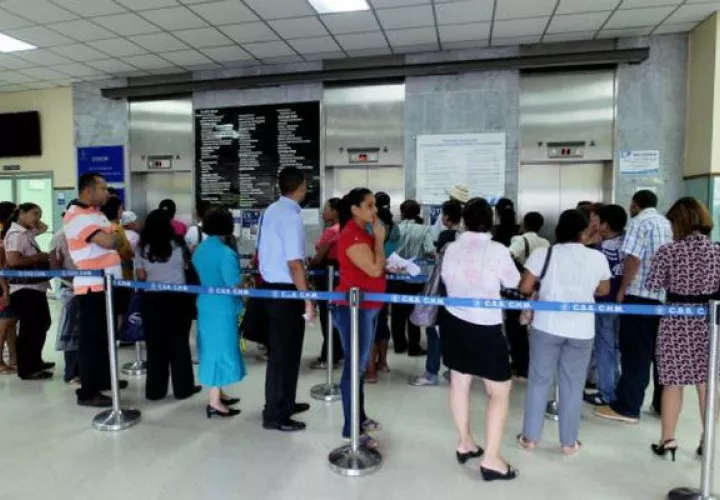
The administration of Juan Carlos Varela has bet the development of the country on important infrastructure and housing projects. However, the healthcare sector has been neglected, to the detriment of the well-being of the population.
Those patient relying on hospitals run by the health ministry (Minsa) and by social security (CSS) have suffered that most. So much so that the health of the general population appears to have deteriorated.
The latest polls carried out by Minsa show how as much as 22% of the population now suffers from some form of diabetes or other chronic disease. Experts agree that the state of the nation’s health is now deplorable.
Domingo Moreno, secretary of the National Medical Commission argued that there has been a deterioration of the healthcare system to the point of it becoming dehumanized, which needs to be remedied by an urgent process of internal coordination within healthcare institutions.
“What is also needed is greater coordination among institutions such as Minsa and CSS” Mr. Moreno explained: “the laws are there, but they need to be implemented”.
Former health minister Carlos Abadia highlighted that the priority has to be solving the problems affecting primary care first and foremost, before secondary problems can be tackled effectively.
“Without addressing primary healthcare problems, we will struggle to try and address more complex issues, in spite of the resources the government may throw at them”, he argued.
More resources
In order to increase resources available to healthcare, the government has proposed the merger of Minsa with CSS. The state would provide annual financing amounting to $528m to the CSS to allow it to cover the cost of the non-insured, explained the former minister.
The budgets of individual hospital such as St. Thomas, the Children’s hospital, the Oncological hospital as well as the Jose Domingo Obaldia would be added to the pot.
“The budgets would have to be revised annually”, Mr. Abadia said.
Minsa has enjoyed budgets as high as $1.511bn for the purchase of medical equipment, and yet it lacked funds to address overcrowding in some of the country’s most important hospital boards.
Nevertheless, the merger proposal has been in the making for years, since it was initially floated three legislatures ago, and in spite of the fact that law 51 of the CSS foresaw a full merger of the two institutions.
According to the former director of the CSS Rene Luciani, political will is the only answer to the current situation. Mr. Luciani also remarked on the necessity of a change in mindset among healthcare workers, who need to put the general public’s interest over and above partisan considerations.
For their part, member of the Panamanian Association of Business Executives (Apede) have voiced their concerns regarding the merger between Minsa and CSS. “We are worried that at some point the government may decide to ban the private sector on ideological grounds of it being the selfish option, when it can in fact provide a more competitive service than the public sector”, the organization said in a statement.
Resignations and scandals
The other reason behind the poor performance of the healthcare sector has been the poor execution on the part of its leaders.
Earlier this year, and in the middle of a H1N1 flu epidemic, health minister Javier Terrientes handed in his resignation. This came after weeks of endless speculation that his departure was imminent, and after the minister failed to attend an important event organized by Minsa itself.
Similarly, CSS director Estivenson Giron has been accused of failing to secure medical supplies and of allowing dubious contracting to occur under his watch.