


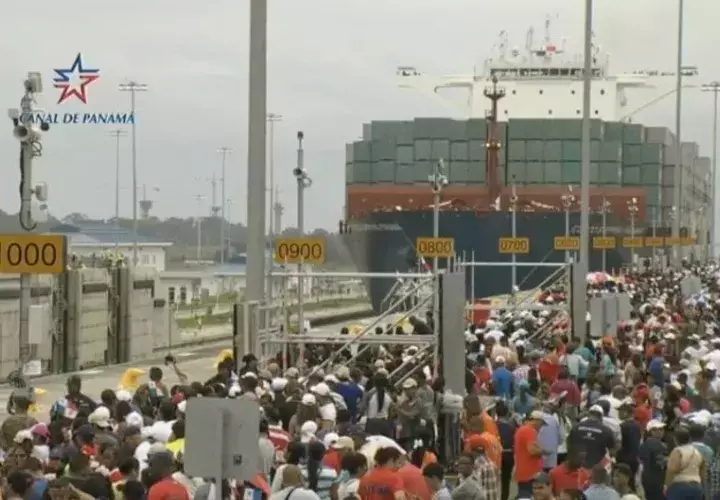
After a construction process that lasted nine years, today Panama and the world witness a new milestone in global commerce, as the enlarged inter-oceanic way is finally inaugurated.
The enlargement project represents the biggest engineering feat the canal has witnessed since its opening in 1914. According to Canal administrator Jorge Luis Quijano, the enlargement project will double the capacity of the waterway and allow it to improve the quality of services to its clients.
The canal inauguration will officially take place at 7.00 AM, when container ship Cosco Shipping Panama, which is owned by Chinese Shipping Company (COSCO), will enter the Agua Clara locks, to begin its crossing towards the Cocoli locks on the Pacific coast.
The inauguration ceremony is expected to be attended by some 20,000 Panamanians, as well as by international dignitaries and heads of state.
The enlargement project began in 2007 and was carried out by construction consortium Grupo Unidos por el Canal (GUPC). 90% of the labor force employed in the construction project, worth $5.25bn, was Panamanian.
According to Giussepe Quarta, president and CEO of the construction consortium that included Spanish Sacyr Vallehermoso and Italian Impregilo, the enlarged canal is arguably the mega project in the firms’ portfolio that is likely to have the greatest worldwide impact: “it is a feast of engineering, an amazing project that Panama must be very proud to have pulled off”, he declared.
The enlargement project of the Panama Canal is likely to remain one of the biggest infrastructure investments the country has seen in the past 10 years. In terms of value, it is only likely to be overtaken by the construction of the metro lines 1, 2 and 3.
Logistics and shipping companies confirmed that the enlarged waterway will not only bring about economic benefits for the country, but is likely to cause reverberations across global trade. In fact,
the enlarged canal is expected to reduce shipping costs by between 7% and 17%, as well as providing a faster and more effective shipping route than Chile, Suez or Africa.
The Panama Canal administrator Jorge Quijano expects the enlarged waterway to generate $400m to $450m in revenues in 2016, rising to $3bn by 2025. Others point out that the Panama Canal will nevertheless have to finesse its business model if it wishes to overcome the new challenges of global commerce.
Mega project
The canal enlargement generated 30,000 jobs, required 4.7m cubic meters of concrete, 4.3m cubic meters of cement and some 321 tons of steel. According to Mr. Quarta, the enlargement project required 100 million hours worked, more than has been employed in Panama in the past 10 years.
On May 31, Grupo Unidos por el Canal (GUPC) delivered the working locks to the ACP, and last Friday it handed over the project in its entirety. GUPC will be responsible for the maintenance of the project for the next three years, and for any malfunctioning. For that purpose, the consortium will keep some 250 operatives in place.
Expectations
According to the president of the college of economists of Panama, Olmedo Estrada, the Panama Canal will need to put in place a new strategy to attract more clients, in the face of a global economic slowdown. Mr. Estrada pointed out that international commerce and trade flows are very sensitive to the general level of economic activity.




In spite of these warnings, Panamanians hold a positive view of the enlarged canal and are confident of the economic benefits it will bring to the nation’s economy. According to recent poll by IPSOS, the Panamanian Chamber of Commerce, Industry and Agriculture (CCIAP), together with a group of businesses, a full 96% of Panamanians consider that the enlarged canal is a positive development for the country: 83% believe the expanded waterway will positively impact the economy, the development and growth of the country; while 60% see the canal has a source of income for the country as well as a strong symbol of its identity.
Such views were echoed by Valerie Cerra, head of mission for the International Monetary Fund in Latin America, who believes the enlarged canal will improve the prospects for the Panamanian economy and consolidate its position as a logistical hub in Latin America. Meanwhile, neighbouring countries such as Costa Rica see the enlarged canal as an opportunity to expand their businesses and exports towards Asian and North American markets.




Últimas noticias